Sidi Ali Azzouz
MAUSOLEE SIDI ALI AZZOUZ
Sidi Ali Azouz is a scholar from Morocco. He settled in Zaghouan in 1672 and died there in 1720. Over the years, he became the patron saint of the city. The architectural richness of the mausoleum demonstrates the worship that the population can have towards Sidi Ali Azouz.

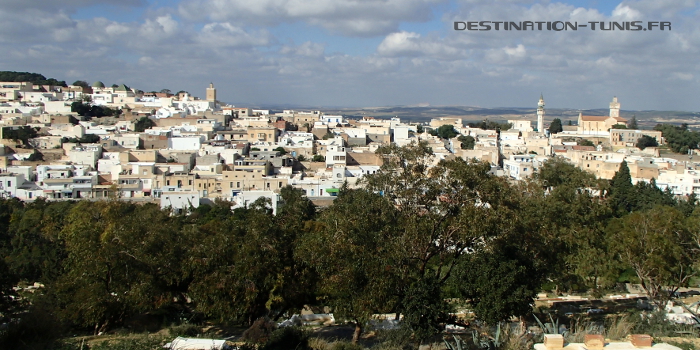
View from the cemetery: we recognize the monuments evoked during the visit: the mausoleum Sidi Ali Azouz and its green dome, the Great Mosque, the Errahba Mosque and the Errahba Church
Hello everyone !
On sunny days, from Tunis, you can see the imposing Jebel Zaghouan which rises due south, behind the Boukornine and the Ressas. This is the Tunisian mountain offering the highest altitude difference between its base and its summit (1295m altitude), where beautiful hikes are possible (ascent of the Grand Peak , for example).
On sunny days, from Tunis, you can see the imposing Jebel Zaghouan which rises due south, behind the Boukornine and the Ressas. This is the Tunisian mountain offering the highest altitude difference between its base and its summit (1295m altitude), where beautiful hikes are possible (ascent of the Grand Peak , for example).
At the foot of the cliffs on the northern slope, the city of Zaghouan has grown around a beautiful Medina with Roman and Andalusian origins; we will discover it during the small circuit presented below.
A little history
The foothills of Jebel Zaghouan have been inhabited for many centuries. The Berbers, the Punics and quickly the Romans have indeed settled in this region to capture and use the most valuable asset for any civilization: water. Indeed, several important sources exist at the foot of Jebel.
Thus, around 130 AD, the Romans built the huge aqueduct connecting the ancient city of Ziqua to Carthage, to supply the capital with water. We talk about it more precisely in this article and we will come back to it a little further down this circuit.
Later, the Arabs settled. The city underwent a major evolution from 1609, with the installation of a large Andalusian community, driven out of Spain (more info on the expulsion of Muslim Moriscos ). The community has imported many architectural, culinary and craft know-how that can still be found today in the old town. Finally, the more recent colonial era has also left many testimonies.
Departure of the visit
To come to Zaghouan:
- From Tunis : take the road to Zaghouan, simply (it is indicated right out of Tunis, at the level of Mourouj and Fouchana). It takes approximately 30 to 40 minutes by car.
- From Hammamet and Sousse : take the highway and exit at Bou Ficha. Zaghouan is then indicated on the panels. Allow about 1 hour from the highway.
- In rent : the station of rent is located in the high street near the Roman Gate, ticket to 4 dinars approximately. In this case, we advise you to walk about 200 meters to the east (the old town on your right) and start the tour directly from this Roman Gate 🙂. You can also take the bus from Bab Alioua to Tunis, there is a departure every hour ( SRTGN site ), bilet 3 dinars.
Geographical coordinates:
36 ° 23'48.59 "N
10 ° 8'40.77" E
Difficulty: [easy]
- Duration: 2 hours, strolling quietly.
- Paved and paved streets, without difficulty in progression.
- Technical: the pavers are well leveled, but there is a little difference in level (the medina is installed on the slopes of a hill). So take a pair of shoes suitable for walking, especially if you plan to walk to the Water Temple 😉
Hiking route

100 m
🙂 Tip 🙂
- To print the plan, open the following file with GoogleEarth software.
- By clicking on the yellow icons, you will see the names of the monuments described in this article.
- In blue, the access road at the start of the hike, in green, the proposed circuit.
Description of the hike
From the central Zaghouan roundabout, where the General Store is located, take the road that climbs towards the Temple of Waters and the Governorate. After 500 meters uphill, there is a new roundabout decorated with mosaics. On the right, direction the Temple des Eaux. Turn left, into the alley that enters the old town.
Park after 300 meters, at a small square that can accommodate a dozen cars.
The tour begins therefore from this small place located on the heights of the old city. This is the place of the Hospital. The hospital is no longer there, but the name has remained. Take the Sidi Ali Azouz street, the main street of the sector, in the direction of the descent.
The tour begins therefore from this small place located on the heights of the old city. This is the place of the Hospital. The hospital is no longer there, but the name has remained. Take the Sidi Ali Azouz street, the main street of the sector, in the direction of the descent.
Public fountains
Walk about 100 meters down the alley towards the dome with green tiles and the arcade over the street.
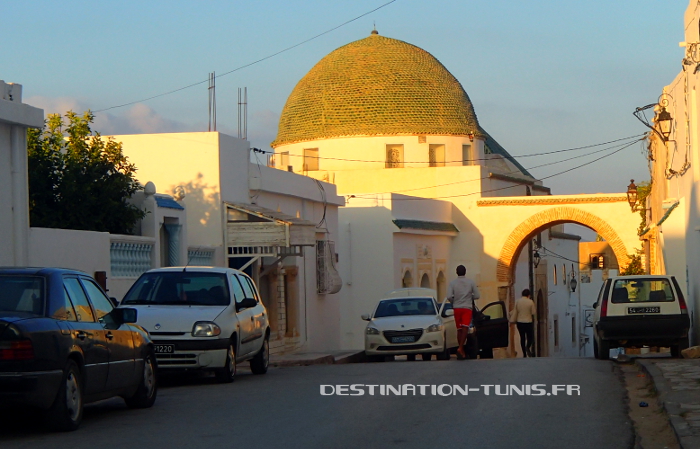
Just before the arcade, on the right (where is the R5 in the picture above), is the first public fountain. The water comes out of a lion's mouth framed by multicolored ceramics.
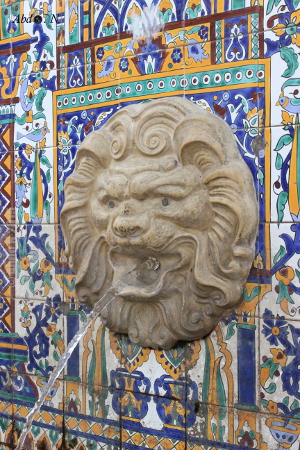
(Photo Abdo.N )
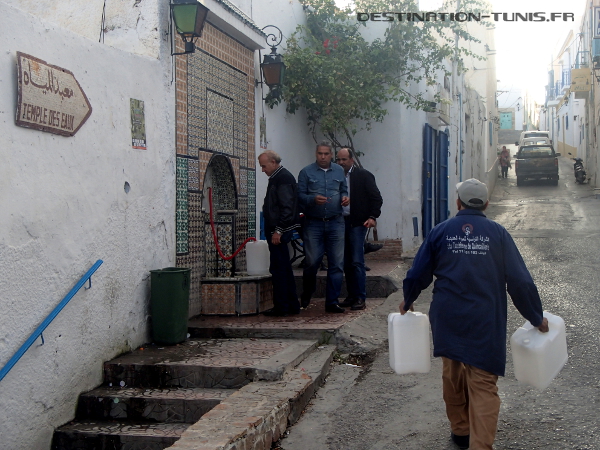
Zaghouan, located near the sources, has developed an ingenious and original irrigation system, to optimize and distribute the use of water to residents. Thus, more than 10 public fountains distributed the water at the corners of the streets of the medina. Since the running water has arrived in every house, the usefulness of the fountains is less. However, many zaghouanis are used to fill cans for their domestic use.
Three fountains still exist, Sidi Ali Azouz Street, Rahba Square and Souk Street, we will see them during the visit. They are adorned with beautiful ceramic panels and always deliver a very refreshing drinking water!
The marabout Sidi Ali Azouz
Just left after the arcade, go through the heavy door allowing access to a nice arched corridor. On the right, a Koranic school has been installed. At the end of the corridor, straight on, a door leads to a small mosque. Finally on the left, a door opens onto a patio decorated with a multitude of ceramics.This is the mausoleum of Sidi Ali Azouz.
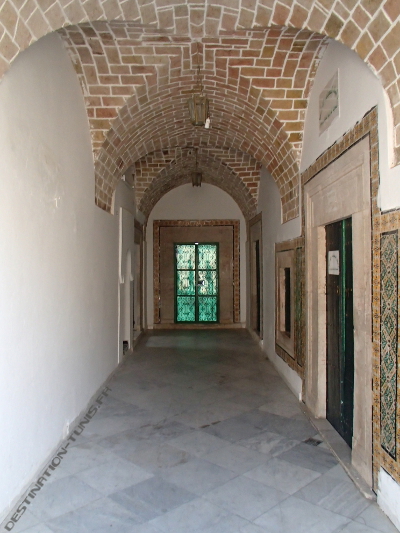
Sidi Ali Azouz is a scholar from Morocco. He settled in Zaghouan in 1672 and died there in 1720. Over the years, he became the patron saint of the city. The architectural richness of the mausoleum demonstrates the worship that the population can have towards Sidi Ali Azouz.
There is also a mausoleum in honor of Sidi Ali Azouz in Tunis ( one of our tours in the medina of Tunis speaks about it). This monument is rather dedicated to the thought and the culture advocated by Sidi Ali Azouz.
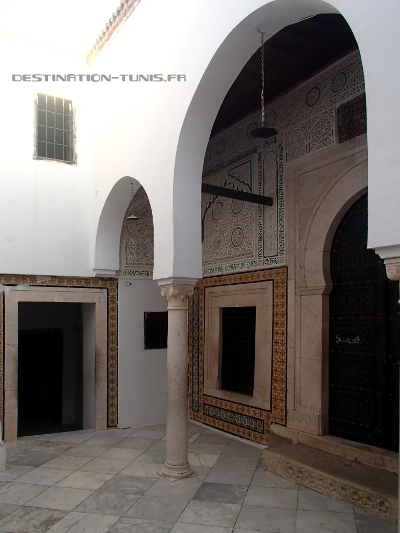
In the patio, a small fountain has been installed, to keep freshness and ensuring good maintenance. A large green door marks the entrance to the mausoleum. If it's closed, you can knock next door, a guard will open it for you.
The architectural and decorative wealth is immense. With ceramics, stucco, stained glass, marble, all the Arab-Andalusian arts are represented here.On the ground, we find swallow wing tiles , black and white, creating multiple patterns. In the center, under an immense dome, rests the catafalque supporting the coffin of Sidi Ali Azouz.

The Great Mosque
Leaving the mausoleum, turn left, always in the direction of the descent. After a few dozen meters, you will walk along the Grand Mosque.
Well, this mosque is not as big as its name suggests, but it is the main meeting point for practitioners in the medina. Its pastel blue colors (even rainwater evacuations are painted!) Are soothing.

The interior of the mosque is also sober and luminous, with pastel tones.
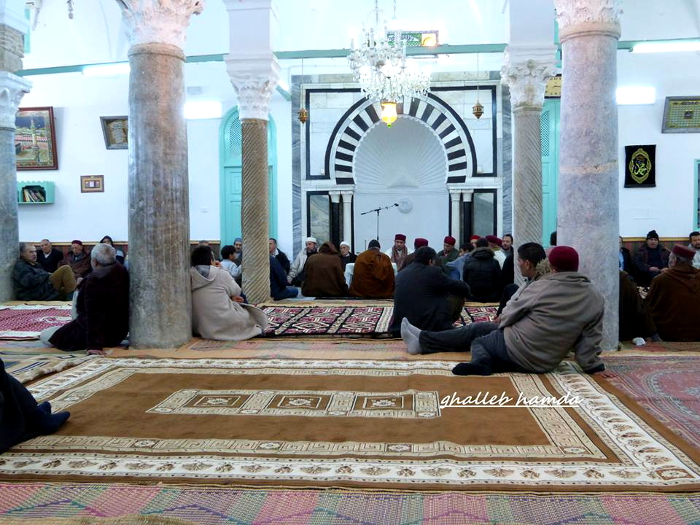
Rahba Square
Continue down the street. In front of you stand almost side by side a minaret and a steeple. We will talk about it in a few lines. On the left, a door opens on the Café El Andalous. Do not hesitate to take a break in this beautiful typical café!
A few more meters, and you get to Rahba Square. This square is the nerve center of the medina, where several lanes converge and where various activities have settled: coffee, florist, ironmonger, bake sellers, but also the Police Station (a good landmark!).
At the corner of Sidi Ali Azouz Street, a new fountain is located:
Just below the fountain, a very beautiful door indicates the Hammam Essouk . This hammam used the water distributed by the municipal network, which explains its installation right next to the fountain. It is unfortunately closed for a few years.
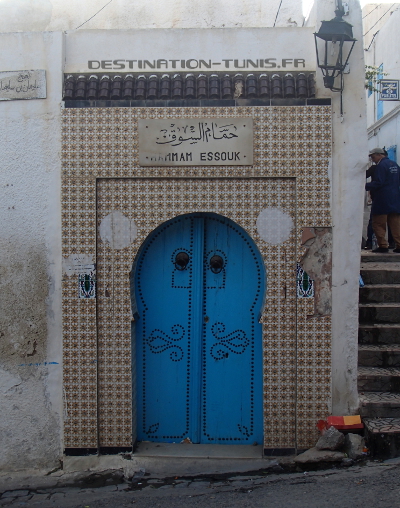
The mosque and Errahba church
Leave Rahba Square, passing Police Rescue and then the cafe hidden under the greenery. Turn left then right. You arrive then on a promontory which dominates the recent city and the agricultural plain of Zaghouan, offering a pretty panorama.
This district is located on the edge of the Arab medina. This is the old colonial district: the protectorate administrations were installed here, including the PTT. These buildings are easily recognizable by their architecture.
At the back, here is finally the mosque and the tower of Errahba. Get closer. Both, installed on a natural promontory, dominate the modern city of Zaghouan and are visible from afar.
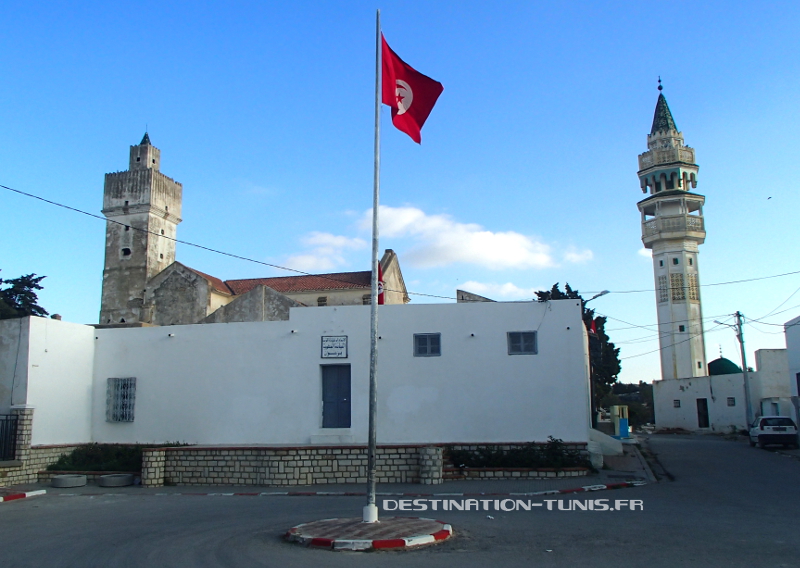
The church is no longer used today. Its maintenance would be assured by France. It is possible to return to see the esplanade and go around the building, if the gate is open. But impossible to enter the church. In the courtyard, buildings were taken over and used as a classroom.

The Roman door
Continue along the alley, leaving the church on the left and the mosque on the right. This beautiful alley, flowery, descends and arrives at the rue du Souk, also called rue Habib Bourguiba. Take a left and walk along the shops and snacks.
After about 50 meters, the street widens. The chairs and tables of a café are installed on the sidewalks: this is the Les Sources restaurant . Go a little and, on the right, take the stairs down. In front of you, the Roman door of Zaghouan.
Built during Roman times, this arch was one of the entrances to the city. Other arches existed but have now disappeared.

Observe in detail the vault of the ark, on the side of the plain. The central stone is engraved, we see a goat's head. It is one of the symbols of Zaghouan, which represents the animal most adapted to the region. Other signs were visible on the other doors, like the olive tree.

Currently, there is renovation work in the area, to highlight this large staircase to move from the modern city to the Arab Medina.
Hamams
Go under the door and climb the stairs, to find the rue du Souk borrowed a few minutes ago. Continue on this street, facing the mountain. After about 100 meters, an alley on the right goes up towards Rahba square. A new fountain is installed at the corner.
Continue the Souk street, horizontally, facing the Jebel Zaghouan, about 100 meters. Just before an arcade overlooking the street, in an alley that goes down on the left, is Hamam el Karma. It is open in the morning for men, and the afternoon for women.
Continue along this quiet street for about 300 meters. Just before the street descends to the left, stop in front of Hamam Jdid. He is on the right, his blue front door surrounded by pink columns is beautiful.

In Tunisian, jdid means new . Yet, this hamam is the oldest in the city. In fact, it took this name after its complete renovation following a collapse. This hamam is open in the morning for women and the afternoon for men. Thus, between Hamam el Karma and Hamam Jdid, everyone finds his account at any time of the day! Ideal for a return of hiking for example!
Hanafia Mosque
Just after the hamam, take the alley that goes up on the right. The first door is in fact the door that allowed to feed the oven of the hamam, when the water was heated with wood.
Very quickly, the lane joins the street Hedi Chaker, by which the hike began. But before joining the car, there are still two monuments to see.
First, on the left, up the street, there is the mausoleum Sidi Saad. Only the dome is visible from the street, access to the interior is not currently possible.
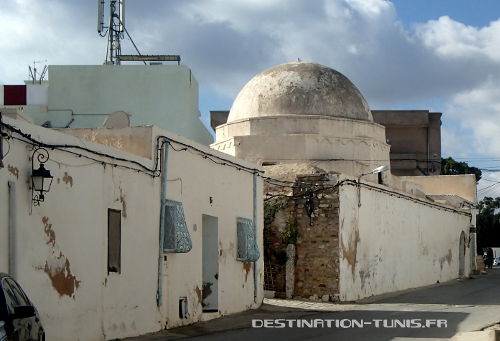
The other monument, the Hanafia Mosque, is located along Hedi Chaker Street, going down a little towards the city center. Easy to recognize by its beautiful minaret, the mosque also has beautiful red brick arches.
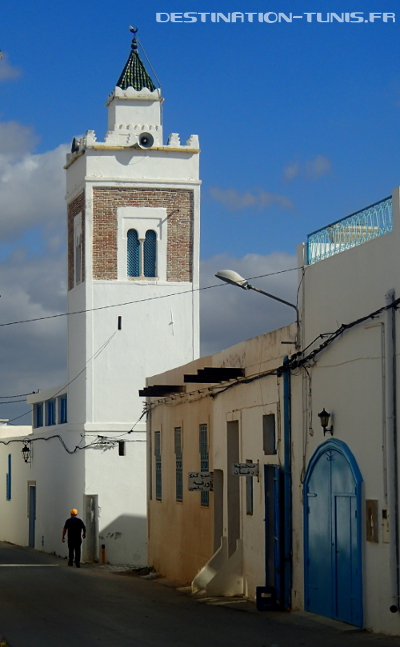

End of the hike
Right next to the Hanafia mosque, there is the hospital square, where you left the vehicle. You will notice that one of the walls of the square has ceramic panels: it is an old fountain, now abandoned.
The warka kaak
But before leaving, a detour is needed to buy some kaak warka , the iconic pastry of Zaghouan.
It is almond paste surrounded by a thin paste, all perfumed with rosehip water, another specialty of the city. The cake is succulent, not very sweet. Its manufacture is artisanal or family. In Zaghouan, each family has its own workshop or knows someone who " makes the best of the city ".
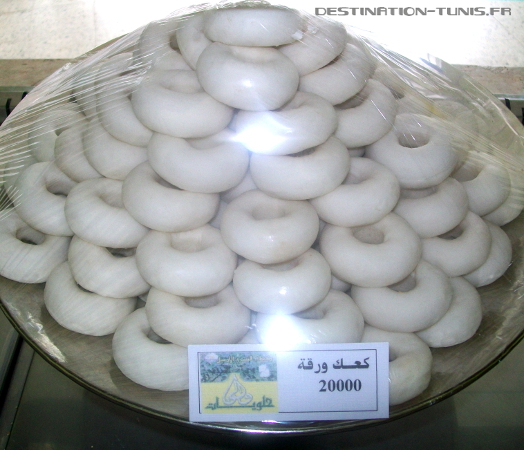
(Photo of my friend zaghouani Meher Melaouhia)
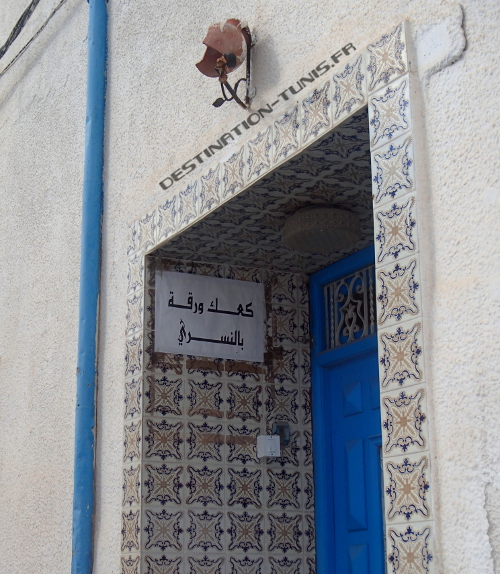
Several shops sell kaaks near Rahba Square. You can also find some by knocking on the doors: the family fabrications are announced by small posters in front of the door:
For further
- To sleep, I recommend Dar Zaghouan , located 3 km from the city center. It's a bit expensive, but the setting is really nice.
- The Association Spéléo and Escalade de Zaghouan (ASEZ) offers various activities in the Jebel Zaghouan (hiking, caving, climbing, mountain biking, dry canyon). Say you come from me 😉
- Hiking trails are available on the site: Grand Pic by Sidi Bougabrine , Sidi Medien , Col Vert
- Various important archaeological sites exist in the area: the Water Temple , which is the source of Zaghouan, but also Oudhna and Thuburbo Majus
Thanks to Hamda , Meher from ASEZ and Abdo.N from the We Love Zaghouan association for visits and multiple news.
Good walk !
[Retoururbaine]
Comments
Post a Comment